Our definition of leadership is too narrow. And because of that, a lot of leadership goes completely unseen.
We still picture a leader as someone with a title, a corner office and a voice that fills the room. We measure leadership by headcount, by hierarchy, by how often someone appears on a stage. And while we keep looking there, some of the most effective leadership I know happens somewhere else entirely: in communities, in classrooms, in villages, in small teams that run better because of one person in them.
This essay is about that other kind of leadership. And about the women who keep showing me what it looks like.
Why I turned to women
When I started my career, I deliberately left Germany. I planned to stay in Amsterdam for a short while. The longer I stayed, the more I noticed the small differences to home, and the more I came to value them.
One of them I only understood much later. At KesselsKramer, the five men who led the agency worked four days a week, because their wives had careers too. Erik, my boss at the time, sometimes brought his children to the office. A fifty-fifty split of work and care at home was simply expected. At least for Erik I know it was true: his wife was a hugely successful woman I quietly admired from a distance. Only later did I notice what I had taken for granted: this progressive model was run by five men.
Before Amsterdam, my internships in Germany had shown me the opposite. Combining a career and children was something women had to sort out on their own. At Springer & Jacoby, there was only one woman in a leadership position, and she had no children.
Still, I thought the glass ceiling was someone else’s problem. It was during my MBA at Rotterdam School of Management that Dianne Bevelander, who founded the Erasmus Centre for Women and Organisations, showed me the patterns behind it. Women are promoted on what they have already proven, men on their potential (Yale Insights). Fransje, one of the women in this series, told me the same in our conversation. The traits we link to leadership are mostly the ones we read as male, and the same traits in a woman are called too much. Some of them made me angry. They also explained a few things I had experienced myself.
When we moved from Amsterdam to Bavaria, my biggest worry was landing back in the old structures. For years, German boards had more members called Thomas or Michael than women (AllBright Foundation). That system lies far outside my circle of influence. But I can take a small step and use my voice to put other women in front, even without 100,000 followers, and encourage them to connect with each other.
If the 100 women I hope to meet end up knowing one another, that is a network that did not exist before.
An ongoing coffee series
It started with something I owed. Over the years I’ve worked with many women I deeply respect, and I had never told most of them. So I asked them for a coffee, in person or on a screen, and finally said it. My goal is at least 100 of these coffees, and this essay will change along the way.
I came with many questions. One of them turned out to matter most: what does leadership actually mean to you?
They come from very different places. A design educator building a new Master’s programme in Singapore. A strategist who just became Managing Director. A creative director whose title never caught up with her work. The founder of a 450-person freelance community in Amsterdam. An HR leader who shapes how a company changes. An entrepreneur who wants women to build wealth. An advisor who redesigned her life with purpose. A consultant who connects West African farmers to global markets. An advertising creative who co-founded a community to make work better for women. A creative director who rebuilt the way she works on her own terms. A commercial builder who grew a learning company for children and now builds one around board games.
Whether or not they appear on a “top leaders” list, all of them lead every day.
What leadership looks like when you stop looking for titles
So far I have met eleven women with eleven very different lives, and the same patterns kept coming back.
Side by side. Krista described leadership as getting the right people around the table and making sure everyone feels heard before a direction is set. She finds the ego-first model wasteful, for the project, for the people, for the company.
In service of the cause. Hanna was once told that what distinguishes her is that it is never about her. She puts herself in service of the work. For her, a good leader takes some of the weight off people’s shoulders without taking the wheel from their hands.
By example. Karin’s definition came without hesitation: never ask your team for something you wouldn’t do yourself. Herma wants to be known for the way she leads: empowering her team to be independent, giving them the confidence to make decisions, and making sure they know which direction they are going.
Without a title. Wendy built a 450-person community from a Christmas party that didn’t exist. Its rules: show up in person, don’t ask for work, give it. “You can be a leader without it being a tick-box corporate thing.”
With honesty. For Dorothy, a leader is a guide who can say “If you don’t know, you don’t know.” She thinks it is rarer than it should be.
As a toolbox that keeps growing. Adelaide learned to own what others had seen in her for years. “Don’t hold on to a fixed idea of leadership. You have to be flexible.”
At home and at work. Lotte sees no difference between the two. In both places, leading means setting an example, guiding from purpose and empowering others.
By seeing the system. Fransje describes leadership as facilitative and inclusive: building psychological safety, understanding the biases at work inside organisations, and knowing what belongs to the system and what belongs to the person. “The system is often not built for women. And that sometimes feels like it’s your fault.”
On her own terms. Mirja learned from a creative director who saw something in her before she saw it herself. Today she leads project teams, put together for one job and then released, and she still leads from the heart.
With space and boundaries. In corporate jobs, Marloes copied the dominant style around her. At Springlab she found her own: giving space without letting go, clear boundaries as guidelines, and the safety to experiment. After six years she left a team that no longer needed her. “Sometimes it hurts to say they’re doing a great job without me. But on the other hand, I’m proud of myself for making sure they were ready.”
And almost all of them had spent years being told that the very qualities they lead with were too much. Too emotional, too soft, too assertive, too quiet.
Why this matters now
AI is now on almost every boardroom agenda. And in many places, the reaction is to hold on even harder to the old image of leadership: hierarchical, ego-driven, title-first.
The women I spoke to see it the other way round. Adelaide put it most clearly: the traits women have been criticised for throughout their careers, the empathy, the softness, the ability to truly relate, are exactly what AI cannot replace. Wendy thinks that as AI reproduces the most obvious version of leadership, people who think differently are about to have a much bigger opportunity. Herma sees the gap in her own field: sustainability teams are full of talented women, yet the VP and chief sustainability officer seats are still largely held by men. Progress is happening, she says, but the gap between participation and power remains. And Marloes reminds us who is coming next: Gen Z and Gen Alpha are the new workforce, and leaders have to meet them where they are.
Karin added a careful question I keep thinking about. Leadership grows from lived experience, from doing and from failing. What happens to that growth when we outsource more and more of our thinking? She has no proof, only a feeling. Fransje sees another gap: women are adopting AI more slowly than men, and many of them tell her it feels like cheating. Mirja uses it where it helps and ignores it where it doesn’t. No prompt, in her view, replaces decades of knowing exactly what you are looking at.
If the machines take over the predictable parts of managing, what is left is the human part: reading a room, building trust, giving direction without taking away freedom. These women practise it every day.
What I take from it
For organisations: look for leadership where it already happens. Who do people call when something is on fire? Who connects the right people? Who makes a team better without being on the org chart? Krista pointed out how routinely companies discount mothers, when the skills that come with motherhood, reading people, holding things together, seeing what someone needs before they say it, are exactly what teams need.
For design: design leadership has always worked this way. We lead through questions, through making things visible, through bringing people to the same table. Karin is teaching the next generation exactly that: systemic awareness and responsibility, things no software can do for them.
For myself: I had worked out what kind of leader I want to be before these coffees began. At Munich Creative Business Week I gave a talk called Nature’s Leadership Blueprint. I looked at transformative, constructive, servant and innovative leadership, and at what the animal world can teach us about each of them. I ended with one line: be the first of your kind. These conversations showed me how many women are already living it, side by side, curious and radically human.
One of them put it well: find each other. Share more. Lift as you climb.
The conversations so far
#RadicallyHuman is an ongoing series.
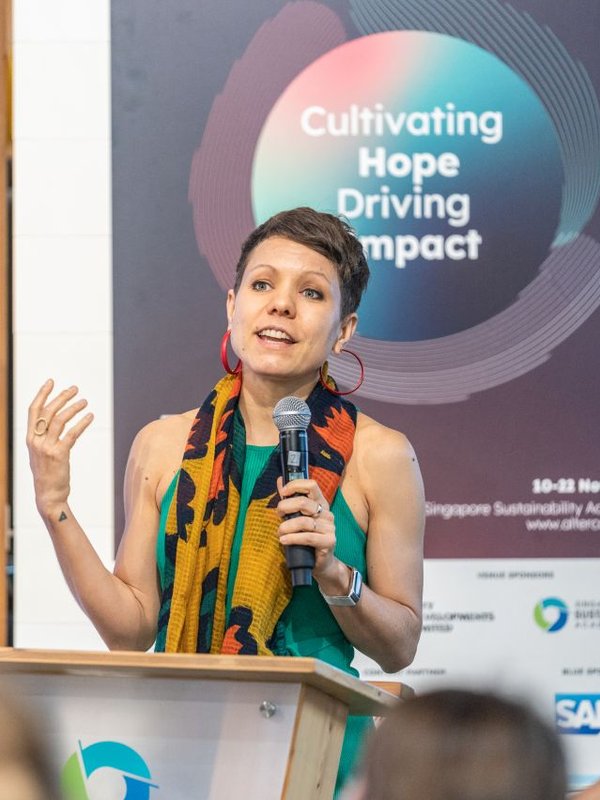 Meet Karin ↗︎
Design educator, NUS Singapore
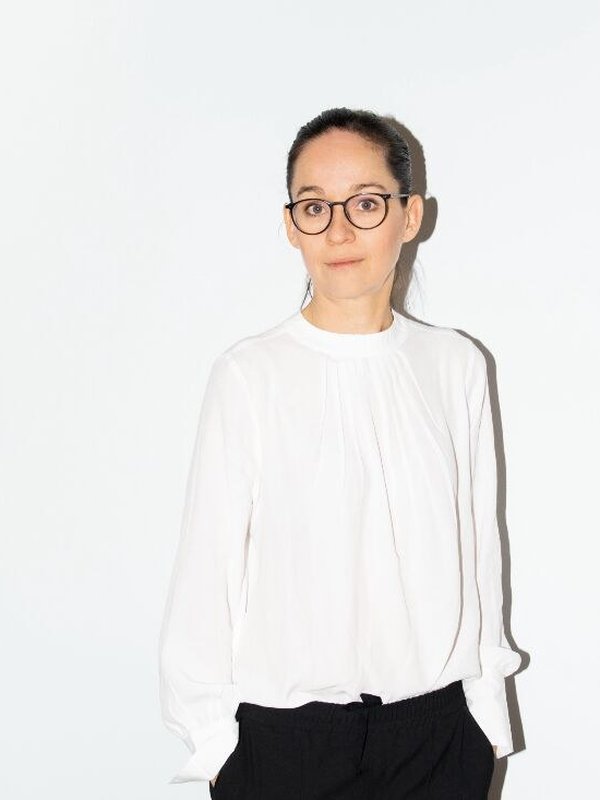 Meet Hanna ↗︎
Strategist and Managing Director
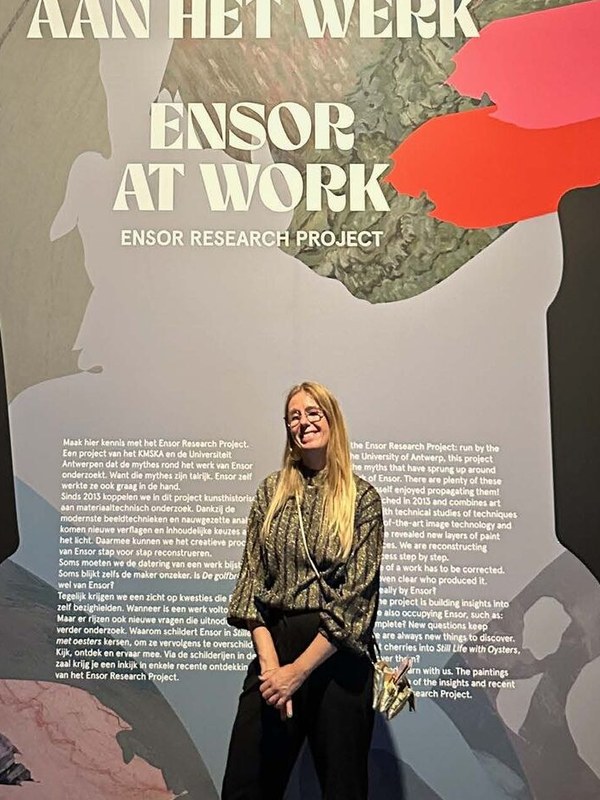 Meet Krista ↗︎
Creative Director
Each portrait is published on LinkedIn, in their own words. Start with the introduction: Our definition of leadership is too narrow.